
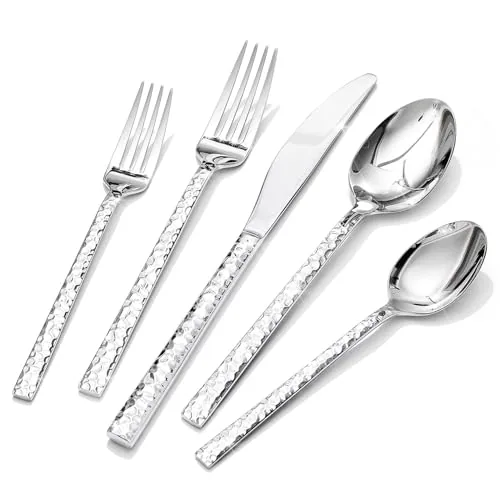
About the Kingstone range
Kingstone tableware covers four groups: stainless steel flatware, china and ceramic dinnerware, kids utensils and kitchen knife blocks. This catalogue lists them together and describes them from the published specifications; it is not the manufacturer's own site.
The buyers differ more than the products do. A flatware set is bought by a household counting places at a table, a knife block by someone equipping a kitchen, and kids utensils by a parent watching a child learn to hold a fork. The range is sized for each of those decisions rather than for a single style.
Sets are counted in people, not pieces
One rule repeats through the catalogue: a cutlery place setting is five pieces and a dinnerware place setting is three. Twenty pieces of flatware means four people, forty means eight, sixty means twelve. A twelve-piece china service is four people; eighteen is six; twenty-four is eight.
The arithmetic matters because the sets are otherwise similar. Once the number of places is settled, what is left to choose is the finish, the rim and whether steak knives are included — decisions that do not change how many people can sit down.
What the specifications actually state
Steel grade is stated as 18/10 throughout the cutlery, with titanium plating or a food-grade black coating on the darker sets. Blade steel in the knife blocks is given as German X50CrMoV15 at roughly 56 HRC, honed at fifteen degrees per side, with one set in 5Cr15MoV instead.
China is described by body rather than by brand language: bone ash above half the mass, firing above 1300C, and in several cases explicit heat resistance and oven use. Care instructions are similarly concrete — dishwasher safe across the range, with abrasive sponges ruled out where a coating is involved.
Anything not stated is absent here too. Where a listing gives no warranty term, no certification and no country of origin, this catalogue repeats the silence rather than filling it in.
Who the Kingstone sets suit
Households furnishing a table for the first time get the most from the range, because a service and a set of cutlery can be matched in one sitting and extended later in the same finish. Larger households are served by the sixty and sixty-five piece sets, which are among the few that reach twelve places without mixing patterns.
Families with small children have a separate path through the catalogue: utensils are marked by age and by length, 5.51 inches from two years and 6.46 inches from four, and the knife-bearing set is stated from five.
What the range leaves alone
There is no glassware, no cookware and no serving dishes beyond the five pieces bundled with the largest flatware set. Patterns are equally restrained: colour and relief carry the differences, and printed decoration is absent across the china.
That narrowness is visible in the catalogue structure. Five categories cover the whole range, and the sets inside each differ by size, colour or rim rather than by concept.